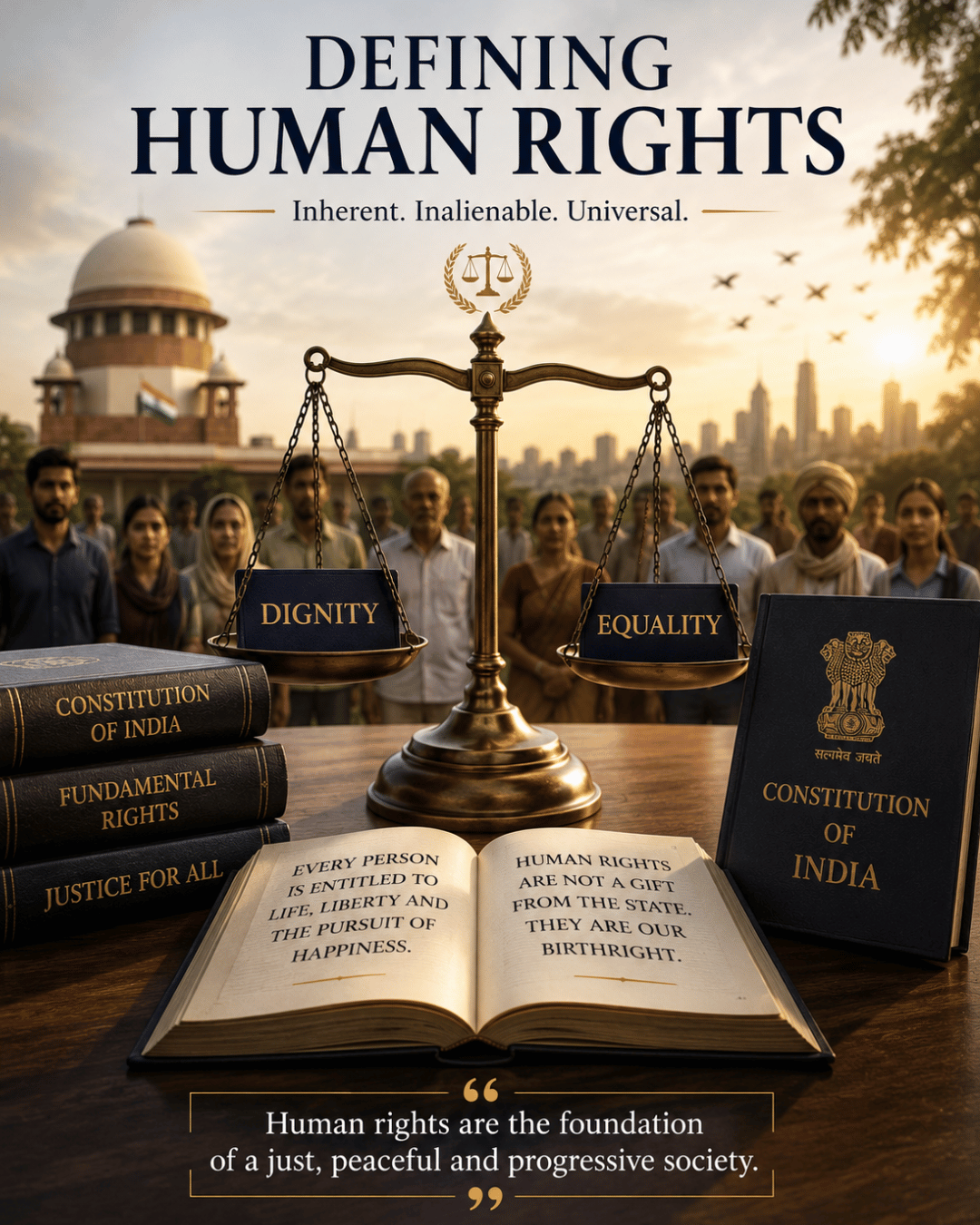
The Formal Scope: Defining Human Rights
While often discussed as a moral philosophy, accurately defining human rights requires looking at them through a strict legal and institutional lens. By definition, human rights are the fundamental, codified guarantees that protect individuals and groups against actions and omissions that interfere with their freedoms, entitlements, and absolute human dignity.
They act as a legally binding social contract between a governing state and its people. Unlike privileges, which can be granted or revoked by an authority, human rights are defined by their inherent nature. You possess them simply by virtue of being born human, regardless of your geographic location, economic status, gender, or belief system.
To define human rights is to establish the absolute baseline of civilized society. It sets the exact parameters of justice, ensuring that there is a universal vocabulary used by international courts, national governments, and grassroots organizations to identify and prosecute systemic abuse.
The Universal Legal Definition
According to the framework established by the United Nations, human rights are universal and inalienable; indivisible; interdependent and interrelated. They are defined extensively by international law, customary international law, general principles, and a vast array of international treaties. When a nation formally ratifies these treaties, it assumes specific, measurable legal obligations to respect, protect, and fulfill the rights of its citizens.
The Dimensions of the Definition
The modern definition of human rights encompasses multiple dimensions of the human experience. It is not limited strictly to physical safety. The legal definition is divided into interconnected categories that collectively define a life of dignity. First, there are Civil and Political Rights, which define an individual's right to participate in the civil and political life of their society without repression. This defines the right to life, liberty, freedom of expression, and equality before the law.
Equally important to the definition are Economic, Social, and Cultural Rights. Legal scholars and international bodies define these as the rights necessary to ensure that basic human needs are met. This includes defining a person's absolute right to work in safe conditions, the right to a fair wage, the right to education, and the right to the highest attainable standard of physical and mental health. Under the international definition, these rights cannot be ranked in order of importance; they are entirely interdependent.
Furthermore, the definition has evolved to include Collective or Solidarity Rights. As global society advances, the legal definition of human rights has expanded to cover the right of marginalized groups to self-determination, the right to a clean and sustainable environment, and the right to cultural preservation.
Ultimately, clearly defining human rights is the most critical step in defending them. By establishing an exact, universally agreed-upon standard for justice, equality, and liberty, the global community ensures that violations can be accurately identified and systematically eradicated. A robust definition prevents authoritarian regimes from redefining justice to suit their agendas, ensuring that the protection of human dignity remains an absolute global mandate.
